Brand Drift in Fast-Growing Startups — Causes and Fixes
How fast-growing teams lose brand consistency through small, invisible decisions.
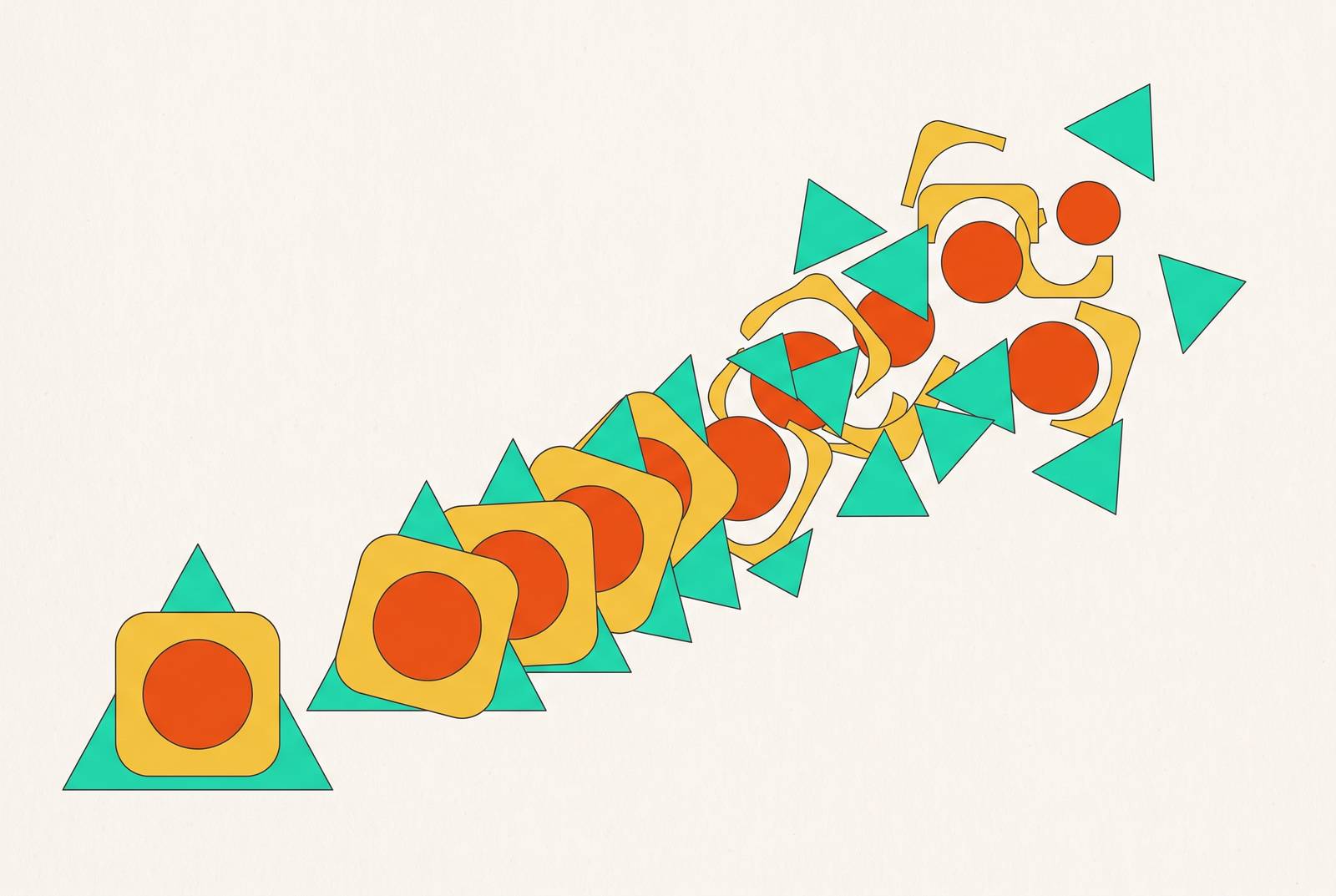
Brand drift is what happens when a company grows faster than its ability to keep saying the same thing, the same way, everywhere at once. It's not a rebrand. Nobody voted on it. One slightly-off sales deck at a time causes the brand that appears in the world to stop matching the one that was supposed to.
Positioning, tone, visuals, the whole customer experience: all of it can quietly wander. Cat&tonic's research draws a clean line here: intentional rebranding is a decision, drift is an accident. Nobody signs off on drift. It doesn't send a memo.
The mechanism is almost boring in how small it starts. A sales rep tweaks a deck because the "new positioning" language felt clunky in a live pitch. A regional team adapts messaging for a local market and never loops back. A campaign goes out with a color that's "close enough." Charlie Xray's Five Stages model (June 2026) lays out how these tiny, individually reasonable calls stack into a pattern that pulls the whole brand off its intended position.
It looks like productivity, which makes it dangerous. Campaigns still ship. The social feed's still posting three times a week. Sales are closing deals. Nothing on the dashboard says anything's wrong. Charlie Xray's piece frames it well: the warning lights are under the hood, not on the dash. You don't hear the engine knocking until it's expensive.
And the stakes aren't just aesthetic. Kevin Keller's customer-based brand equity model, along with the Ehrenberg-Bass Institute's work on distinctive assets, both point to the same mechanical truth: brands create value by building recognizable signals that people can place without effort. Break that consistency and you break the recognition. A brand nobody can instantly place is a brand that's harder to remember, harder to trust, and harder to buy from without a second thought.
How drift spreads through a growing organization, the five stages
Charlie Xray's Five Stages of Brand Drift (June 2026) is less a strict ladder and more a map of exposure zones. Companies can skip stages entirely if internal misalignment turns visible to customers fast enough. Each stage has a different smell.
Stage 1 is the execution slip. One asset, one decision, one deviation. A font substitution because the correct one wasn't available. Harmless, alone.
Stage 2 is team-level drift. Designers start "interpreting" the guidelines instead of following them. Sales decks mutate rep by rep. Marketing runs "just this once" creative for a special campaign, but Charlie Xray's piece notes it's never just once. That phrase should be printed on a poster in every marketing office, mostly as a warning.
Stage 3 is channel fragmentation. The ads feel disconnected from the website. LinkedIn's voice is warm and human while the email cadence reads like it was drafted by a nervous lawyer. These are live, in-market debates, and customers are seeing the seams. They're live, in-market, and customers are seeing the seams.
Stage 4 is the audience perception shift. This is the quiet, dangerous one. Customers stop being able to subconsciously confirm "yes, this is the brand I know." The brand gets harder to categorize, harder to recall on demand. Nobody complains about it directly. They just remember you a little less.
Stage 5 is erosion. Weaker trust signals. Rising acquisition costs. Conversion rates that soften for no single obvious reason. Charlie Xray's research notes that investors tend to see chaos exactly where the internal team sees creative freedom. That gap in perception is its own kind of expensive.
Charlie Xray's contamination metaphor holds up well: drift doesn't behave like a single broken part. It behaves like something spreading through a system, touching one asset, one team, one channel at a time until it's everywhere at once.
None of this discriminates by size. Jaguar's move away from its own heritage, Cracker Barrel's attempt to sand off its identity before reversing course under public backlash, Southwest walking back positioning it spent decades building: these examples get cited in the research as evidence that scale offers no immunity. Starbucks is the more instructive case, though. Ninety's podcast notes that the brand's coherence lived in a person, not a system. Remove the person, and the drift accelerates on its own.
The structural causes that make fast-growing startups especially vulnerable
Three structural causes recur across the research, and none of them are about bad taste or careless people.
Freelancer and contractor handoffs are the first. Brand knowledge tends to live only in the heads of whoever's been there the longest. Hand a thin brief to an outside contributor and watch them fill the gaps with guesswork, because guesswork is the only option they've got.
Second: brand documentation that's stale the moment it's printed. A one-page brand brief written during onboarding two years ago isn't a brand guide anymore, it's a fossil. Campaigns pivot. Audiences shift. Documentation almost never keeps pace, because updating it isn't anyone's job description.
Third, approval bottlenecks that quietly reward shortcuts. When sign-off takes too long or nobody's sure who actually owns it, assets get pushed live half-reviewed. Standards don't erode because people stop caring. They erode because friction makes the easy path look like the right one.
Cat&tonic's piece names three cultural accelerants that are structural forces, not personality flaws. Speed-obsessed cultures treat "fast" as more important than "right," and consistency is always the first casualty of that trade. High-pressure, low-resource teams end up handling brand work themselves just to survive the week. And disconnected leadership tends to outsource brand to the marketing department instead of living it across the whole org, which guarantees marketing is fighting a battle nobody else signed up for.
Charlie Xray's research names this the "everyone's job" trap: when brand guardianship belongs to everyone, in practice it belongs to no one. No guardrails get built into the daily tools people actually use, so everyone improvises on the fly.
Cat&tonic also flags leadership change as its own drift vector. New stakeholders arrive with personal preferences that quietly diverge from what's already established, not out of bad faith, but because nothing in the system forces continuity across a transition.
And often the brand strategy itself is trapped in a slide deck sitting in a shared drive somewhere, disconnected from the sprint reviews and sign-off workflows that actually shape what ships. Drift is the predictable output of any system that depends on memory, goodwill, and ad hoc judgment calls instead of senior ownership and guardrails built into the daily workflow.
Why the absence of a single senior creative voice is the root cause, not a symptom
Most teams aren't short on talent. Somewhere in the org, there's a designer who's good, a copywriter who gets the voice right most of the time, a marketer who knows the customer cold. What's missing is the person who looks across all of that output at once, makes the final call, and holds the line week after week, campaign after campaign.
Without a creative director sitting above the junior or mid-level designer, somebody still ends up making the final creative calls. Usually that's the founder or the marketing lead, whether or not they signed up for the job or have the time for it.
This is a governance gap, not a production gap, and the distinction changes what actually fixes it. More templates and a tighter style guide treat the symptom. The structural hole, the missing senior judgment, stays open regardless.
Back to Starbucks: Ninety's podcast frames the pattern cleanly. The brand held together while the founding-era leader was present and drifted when that person left. Coherence lived in a human being instead of getting built into a system that could survive the person leaving the room.
A senior creative voice does four things a style guide physically cannot:
- Reads across every output at once and catches drift before it compounds into a pattern
- Makes the judgment call in the gray areas, instead of leaving each contributor to guess
- Protects the brand during the highest-pressure moments: launches, pivots, leadership changes, exactly when drift risk spikes
- Enforces the standard as a living practice, not a filed PDF nobody reopens
Cat&tonic's framing gets at the heart of it: brand is how a company operates, not just what it says in its marketing copy. That kind of standard needs a person enforcing it in real time. A document can't enforce anything. It just sits there, filed and forgotten, while the drift builds anyway.
There's a newer wrinkle here too. Brand confusion is increasingly a discoverability problem, not just a perception one. When a brand stops signaling clear, consistent relevance, visibility can collapse along with it. Those are two very different fires to put out.
The fix on the table is ownership: one senior voice accountable for the standard across every asset, every channel, every contributor, no exceptions carved out for "just this once." It's ownership: one senior voice accountable for the standard across every asset, every channel, every contributor, no exceptions carved out for "just this once."
What early-stage drift looks like in practice, and how to run a fast diagnostic
Drift leaves fingerprints before it becomes a full-blown identity crisis. Cat&tonic's research and Charlie Xray's piece both point to the same observable signs.
Visual inconsistencies are the easiest to spot: a logo cropped differently depending on who exported it, colors that drift slightly by channel, typography that changes without anyone deciding it should. Tone divergence is subtler but louder once noticed. Warm and casual on LinkedIn, buttoned-up and formal in email, oddly robotic on the product pages, like three separate companies took turns writing the copy.
Then there's the vaguer, harder-to-pin-down signal: a stakeholder or customer says the brand feels "off" lately, without being able to explain exactly why. And there's the competitive tell Charlie Xray calls out directly: losing pitches to competitors who have less actual capability but sharper, more consistent clarity. Clarity wins pitches that capability alone should have won.
Running the diagnostic doesn't require a six-month audit with a consulting firm attached. Charlie Xray's Brand Pulse Check framework keeps it lean: pull live assets from across different teams and channels, score them against a simple consistency rubric (this isn't about chasing perfection, it's about checking whether the signal is still clear), then ask one blunt question. Do these assets look like they came from the same company? Would a brand-new customer, seeing each one separately with no context, land on the same mental picture of who this company is?
A useful internal test: if the people inside the company can't agree on what the brand actually stands for, external audiences never will either. Internal alignment is a leading indicator, visible well before customers notice anything.
The real tell is the gap between the strategy deck and what's actually in the wild. The deck says one thing. The live assets, out there being seen by real customers, say something a little different. That gap, however small it looks on any single asset, is exactly where drift lives and grows.
This is a signal, not a verdict. Ninety's framing treats drift as a natural part of growing a company, not evidence of failure. The founder's job is to catch it and re-anchor, not to burn the whole brand down and start over from a blank page.
The operational fix (how to build a system that holds the brand without constant oversight)
Brand consistency doesn't come from someone standing over every shoulder checking hex codes. It comes from senior ownership built into the workflow from day one, so the review loop is part of how work gets made, not a corrective step bolted on after drift's already spread.
A working system needs a few concrete pieces. First, a single named owner of brand standards, not a committee and not a vague nod to "marketing owns that." One person whose judgment breaks the tie when there's a disagreement. Second, brand documentation that actually stays alive, tracking campaign pivots and positioning updates as they happen, instead of a static PDF frozen in whatever quarter it got written.
Third, and this is where Charlie Xray's BrandOps framework earns its keep: guardrails built directly into the tools people use every day. Color palettes locked at the software level so nobody can accidentally pick the wrong blue. Asset libraries that remove the guesswork instead of relying on someone remembering the rules. Brief templates that already encode the brand voice before a single word gets written, so the default output is on-brand rather than off by accident.
Fourth, regular pulse checks on live, in-market assets, not an annual audit that finds problems eight months after they started. And fifth, clear approval ownership: who signs off, at what stage, no ambiguity left for anyone to slip an unreviewed asset through the cracks.
Charlie Xray's research pushes one step further: tie brand discipline to an actual business number. Track a consistency score against win rates, customer acquisition cost, or NPS. Make it something measurable on a dashboard, not a "nice to have" that gets cut the first time budget's tight.
The prerequisite that produces all of it: consistent external messaging starts with internal agreement on what the brand actually stands for. The fix starts inside the organization, in a room full of employees arguing about positioning, and only later becomes visible in an asset library.
None of this demands policing fonts with a ruler or slowing production to a crawl. It doesn't require the founder sitting in on every creative decision either. The entire point of building the system is that it runs on its own, without that overhead sitting on someone's calendar every week.
Why fractional creative leadership is the structural answer for most startups
A fractional creative director is, almost exactly, the missing senior voice this whole piece has been describing. Not the person doing the design work. The person making sure the design work, wherever it comes from, is actually right.
A fractional creative director sits in leadership meetings, sets creative strategy, manages the brand system across the whole company, and mentors the team, unlike a freelancer, who takes a project, finishes it, and moves on. A freelancer takes a project, finishes it, moves on. A fractional creative director sits in leadership meetings, sets creative strategy, manages the brand system across the whole company, and mentors the junior creatives already on staff. It's embedded leadership with a fixed schedule, not an outside vendor waiting for the next brief to land in their inbox. Think of it less like hiring a contractor and more like retaining outside counsel: someone who knows the business well, owns the standard, and doesn't need a desk five days a week to do it.
In practice, a fractional CD reviews work across every contributor and channel, not just the projects assigned directly to them. They build the design systems and set the standards that keep consistency intact once they're not in the room. And they occur specifically at the moments when drift risk peaks: campaign kickoffs, quarterly brand reviews, leadership transitions. Typical engagements run 10 to 20 hours a week, two or three days on the calendar, stretched across six to twelve months before anyone decides whether to renew.
The economics tend to get founders' attention fastest. A fractional creative director runs somewhere between $5,000 and $15,000 a month for genuinely executive-level creative leadership. Compare that to a full-time creative director, where Glassdoor's average base is near $158,000 and the top quartile clears $210,000 (figures for the country the Bureau of Labor Statistics puts the median for the closest occupation at $111,040 as of May 2024). That's a large gap. That's a different budget category entirely.
The market's already voting with its feet here. Fractional work overall grew by 100% over two years, with demand up 68% year-over-year between 2023 and 2024, and job postings using "fractional" titles jumping 400% between 2022 and 2024. Read directly, this is not a fad; it is the market catching up to a need that's existed the whole time: growth-stage companies have always needed this kind of senior judgment, they just couldn't afford or access it before the fractional model made it possible.
There's an economic tailwind behind the shift too. Digiday reported that geopolitical instability and general economic uncertainty have made ad spend forecasts genuinely hard to plan around. When budgets swing unpredictably quarter to quarter, variable creative costs are the structurally smarter bet over fixed headcount that has to get paid whether the budget holds or not.
Fit matters, though, and it cuts both ways. A fractional CD makes sense when a startup already has in-house designers who need senior direction, so the actual problem is governance. It's the wrong fit when there's no design capacity at all yet: creative direction without anyone to execute it is strategy with nothing to push against. And past a certain revenue scale, once the volume of recurring creative work is high enough and steady enough, a full-time hire can start to make more economic sense than a fractional arrangement.
Catching drift before it compounds, the founder's role as keeper of the brand
Founders don't need to become designers, and they don't need to approve every social media caption personally. What they do need is to treat brand coherence as a structural responsibility, the same way they'd treat cash runway or a hiring plan, instead of something that gets attention only after a customer says the company feels "off."
The pattern running through all five stages of drift is that nothing looks urgent until it's expensive. Campaigns keep shipping. Deals keep closing. The dashboard stays green while the actual signal, the thing customers use to recognize the brand without thinking, gets a little blurrier every quarter.
Catching it early doesn't take a six-month audit or a rebrand. It takes a fast pulse check across live assets, an honest look at whether internal teams agree on what the brand stands for, and a structural answer to the question of who's actually accountable when something drifts. For a lot of growth-stage companies, that answer isn't a bigger internal team or a thicker brand guide. It's one senior voice, whether fractional or full-time, whose entire job is making sure the brand people meet on Tuesday still looks like the brand they met on Monday.