web design subscriptions with dedicated designer access vs. team-pool models
Dedicated designers build brand memory; pools trade depth for specialized skills.
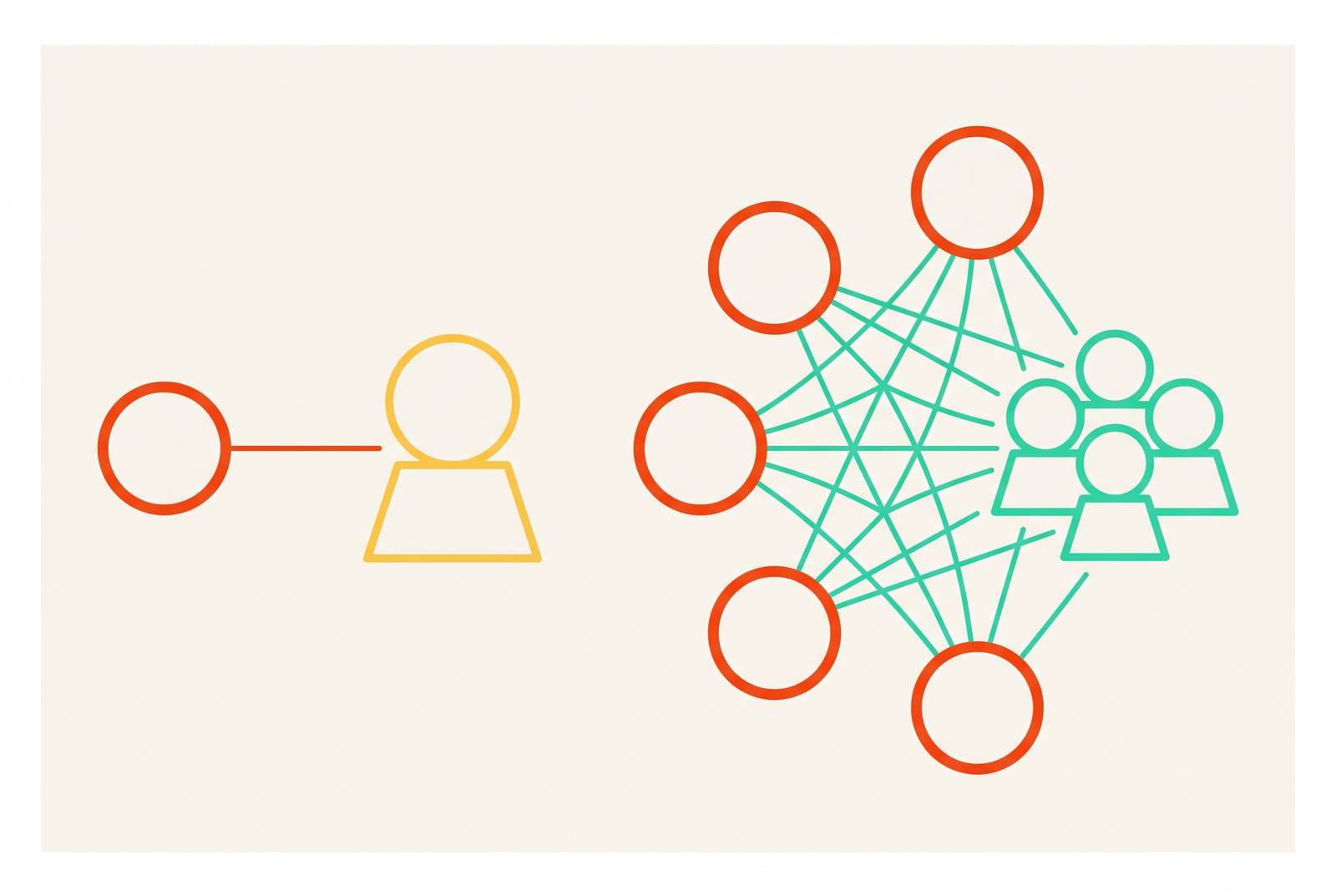
A web design subscription splits into two structures: a dedicated designer who stays on your account, or a rotating pool that hands your work to whoever's free. That choice matters more than the price tag, because it decides whether your brand knowledge builds up over time or gets wiped clean with every new request. Most providers bury this distinction below the pricing table. Pool models are the wrong default for anyone whose brand isn't already locked down, no matter how good the QA process sounds on the sales page.
A dedicated model means one named senior designer sticks with your account, request after request, learning your brand the way a new hire would. A pool model routes each task to whoever fits: your social carousel goes to the social specialist, your dashboard mockup goes to the UI person. Neither model gives you ten things worked on at once, by the way. "Unlimited requests" means an unlimited queue, not unlimited hands. Most providers work through a queue, meaning only a limited number of active tasks move forward at any given time, whether it's a single designer or a team of twelve behind the curtain. Providers rarely spell this out, because "unlimited" sells better than "one thing at a time, but you can queue up as many as you want." Plans run from $149 a month to well past $5,000, and price alone won't tell you which structure you're buying. Two questions decide that: who's learning your brand, and who decides who touches your work?
What dedicated access actually delivers beyond convenience
A designer who's worked through 30 requests for the same account remembers the founder hated that navy blue back in week two, without being told twice. That's the entire value of the model: institutional memory that lives in one person's head instead of a shared drive full of PDFs nobody rereads.
Practically, the client stops acting as an unpaid creative director. Someone else owns the visual standard, and every new brief doesn't need a refresher course on brand voice tacked onto the front of it.
There's a compounding effect too. The first few requests with a new dedicated designer move slower, because they're still calibrating. Then it speeds up. Briefing overhead shrinks, revision rounds drop, and the whole relationship gets faster with age, the way a pair of boots breaks in rather than staying stiff. Pool models never get that benefit. Every new designer resets the clock, no matter how thorough the brand guide is.
ManyPixels, a managed-design subscription service, reports that 72% of its customers choose the Assigned Designer plan ($1,399/mo) or the Design Team plan ($2,599/mo) over the cheaper managed-pool tier at $699/mo. Once buyers see both options side by side, most pay more for continuity, not less. That's not a marginal preference, that's a verdict.
There's still a ceiling, though. One designer means one skill set and one set of working hours. If a month suddenly needs motion graphics, a full UI redesign, and print collateral all at once, a single person hits a wall fast, and no amount of loyalty fixes a bandwidth problem.
What team-pool models trade away and what they gain in return
Pool models make a real trade: relationship depth for task-specific skill. A social carousel goes to somebody who lives in that format daily. A SaaS dashboard screen goes to someone who's spent years building interface patterns in Figma. For teams juggling wildly different request types, motion one week, print the next, web UI after that, sharper output per task is possible in a way one generalist can't quite match.
The tradeoff shows up as brand drift. With nobody tracking every decision, each designer on the roster interprets the brand guide instead of having internalized it. Guides set a floor, not a ceiling, and five designers reading the same document will still make five slightly different calls on tone, spacing, and color.
Pool models also ask more of the client, not less. Briefs need to be tighter. Style documentation needs to be more exhaustive. Revision tolerance needs to go up, because a new designer starts cold on every single request. Some of the management overhead the subscription was supposed to remove quietly creeps back in through the side door.
Process can patch part of this, not all of it. ManyPixels routes work through a project manager and a QA reviewer at its $699/mo Advanced tier before anything reaches the client, which catches the obvious failures: a rogue font, a color three shades off. But that's process-level consistency, not relationship-level consistency. A QA checklist can flag "wrong blue." It can't flag "this doesn't sound like us," because it doesn't know what "us" sounds like the way a dedicated designer eventually does.
The pool model fits teams with real volume, real format diversity, and a brand system documented well enough that any competent designer can execute inside it without guessing. Outside those conditions, it's the wrong tool, full stop.
The brand consistency problem neither model solves on its own
Brand consistency at scale needs someone setting the standard, not just someone executing against it. That distinction gets lost in both models, and pretending otherwise is where most buyers go wrong. A dedicated designer can still drift over months if nobody checks their work against strategy. A pool can still ship on-brief, on-brand work if the system behind it holds up. Neither structure guarantees the thing people actually want: a brand that looks like itself six months from now.
Plenty of growing companies buy execution capacity without any strategic layer sitting above it. Somebody still has to make the calls, a founder, a marketing lead, whoever's around, and that person ends up doing creative direction as an unpaid side job nobody hired them for.
A fractional creative director closes that gap. It's worth being precise about what the role does and doesn't do. It shows up for strategic planning. It sets the rules for the brand system. It reviews work before it goes out the door. It mentors whoever's doing the execution-level work. It does not open Figma and draw boxes.
The cost math makes the case on its own. A fractional creative director runs $5,000 to $15,000 a month. A full-time creative director, per Glassdoor, carries a median salary of $157,926 a year, with the top quartile clearing $210,000, before benefits, before equity, before the overhead of managing someone full-time. Fractional buys the strategic layer without the full-time price tag attached to it.
Operationally, fractional creative directors tend to work 10 to 20 hours a week, spread across two to four clients, in engagements running six to twelve months. That's embedded leadership, showing up regularly enough to matter, not a consultant parachuting in once a quarter to drop off a slide deck and vanish.
A fractional creative director with nobody underneath doing the actual work is strategy with no leverage behind it. Subscription execution and fractional direction work as a pair. Neither one substitutes for the other, and buying only one half of the pair is how brands end up with polished work that still doesn't hang together.
How to read the provider landscape before committing
The single most common regret among buyers: signing up, then discovering web design or motion graphics sit outside the entry tier. Check scope before price, always.
Promotional pricing compounds the problem. A rate that doubles after a few months, a pattern confirmed in the market as of August 2026, means the number on the landing page isn't the number that matters. The regular rate is the real price. Budget against that number, not the teaser.
Here's how providers break down by structure, prices verified as of August 2026.
Dedicated-designer side: Delesign starts at $649/mo with a dedicated designer working a chosen shift, though web design and motion graphics require stepping up to its Agency Booster tier at $849/mo, and web development is a separate paid add-on (15-day money-back guarantee; entry pricing has climbed twice recently). Undullify runs $149/mo, no web design included, no trial or guarantee, built for simple, repeatable tasks rather than complex builds. UnicornGo is $499/mo, no web design at entry, a 14-day money-back window, oriented toward teams working AEST hours.
Managed-pool side: ManyPixels leads with its $699/mo Advanced plan, a managed queue backed by a project manager and QA review, web design included from the start, plus an Assigned Designer plan at $1,399/mo, a Design Team plan at $2,599/mo, and a Business plan at $1,199/mo adding motion and video. It carries a 4.8 out of 5 on Trustpilot, over 150,000 projects delivered across more than 2,000 businesses since 2018, and a pause option for $10/mo. Graphically enters at $449/mo with both web design and motion graphics included, plus a 7-day risk-free trial, probably the broadest scope available at that price. Design Shifu runs $549/mo, web design included at entry, 14-day money-back. Kimp advertises a promotional rate around $699/mo for the first four months only, before jumping to its regular rate of $1,397/mo, so budget against that number, not the introductory one; it includes landing pages and web UI, with a 7-day free trial.
Development is where a lot of these plans quietly stop. Of more than 400 providers tracked in 2025, fewer than 10% include development in their standard plans. If the goal is a design that actually goes live on a working site, get that confirmed in writing before signing anything. Don't assume it's baked in.
The comparison that actually matters weighs four things against each other, not price against price, including model type, whether web design is included at entry, the real non-promotional price, and whether a QA or project-management layer exists alongside the trial terms. Line those up side by side and the right fit gets obvious fast.
The signals that tell you which model fits your situation
Pick a dedicated designer if the brand is still being built, or still changing shape. Relationship-level consistency matters more than task-by-task specialist matching when the thing itself hasn't settled yet. It also fits when request volume is steady and moderate, when the team can't absorb re-briefing on every task, and when nobody internally owns creative direction. In that case, the dedicated designer becomes the closest thing to brand memory the team has.
Pick a pool model only when request types are genuinely scattered, motion, UI, print, and social all showing up in real volume most months, and the brand system is mature enough that any capable designer can run with it unsupervised. It also fits when throughput matters more than continuity (think campaign bursts rather than steady weekly output), and when the provider has QA and project management built in to catch problems before they ship. Outside those specific conditions, the pool model asks for more management than it saves.
Whatever model gets picked needs to scale without piling on more briefing overhead, because output volume only moves in one direction from here. That's not a hunch, that's just what happens as teams grow and marketing calendars fill in.
The real question has nothing to do with dedicated versus pool: does anyone on the team actually have the authority and the time to set the brand standard? If not, adding execution capacity in either model speeds up drift instead of fixing it. A service that pairs a dedicated designer with a fractional creative director and project management, all under one flat monthly rate, closes that gap directly: brief intake, revision management, quality review, and strategic alignment, handled without the client ever acting as its own creative director, Zyner, a fully managed creative subscription, is one example structured exactly this way. Some providers are beginning to structure their offerings this way, bundling strategic oversight into the subscription itself instead of treating it as a separate hire bolted on later.
The cost comparison, in the end, makes the decision easy. A mid-level in-house designer runs roughly $102,800 a year fully loaded, about $8,570 a month, before adding in the cost of managing that person. A subscription running $4,800 to $12,000 a year covers the same recurring design need at a fraction of that cost, with no 44-day hiring cycle and no three-to-five month scramble when someone eventually quits. The math isn't close, and it was never supposed to be.