Brand Architecture Models and When Startups Should Choose Them
Clear brand architecture prevents costly confusion as a company grows beyond one product.
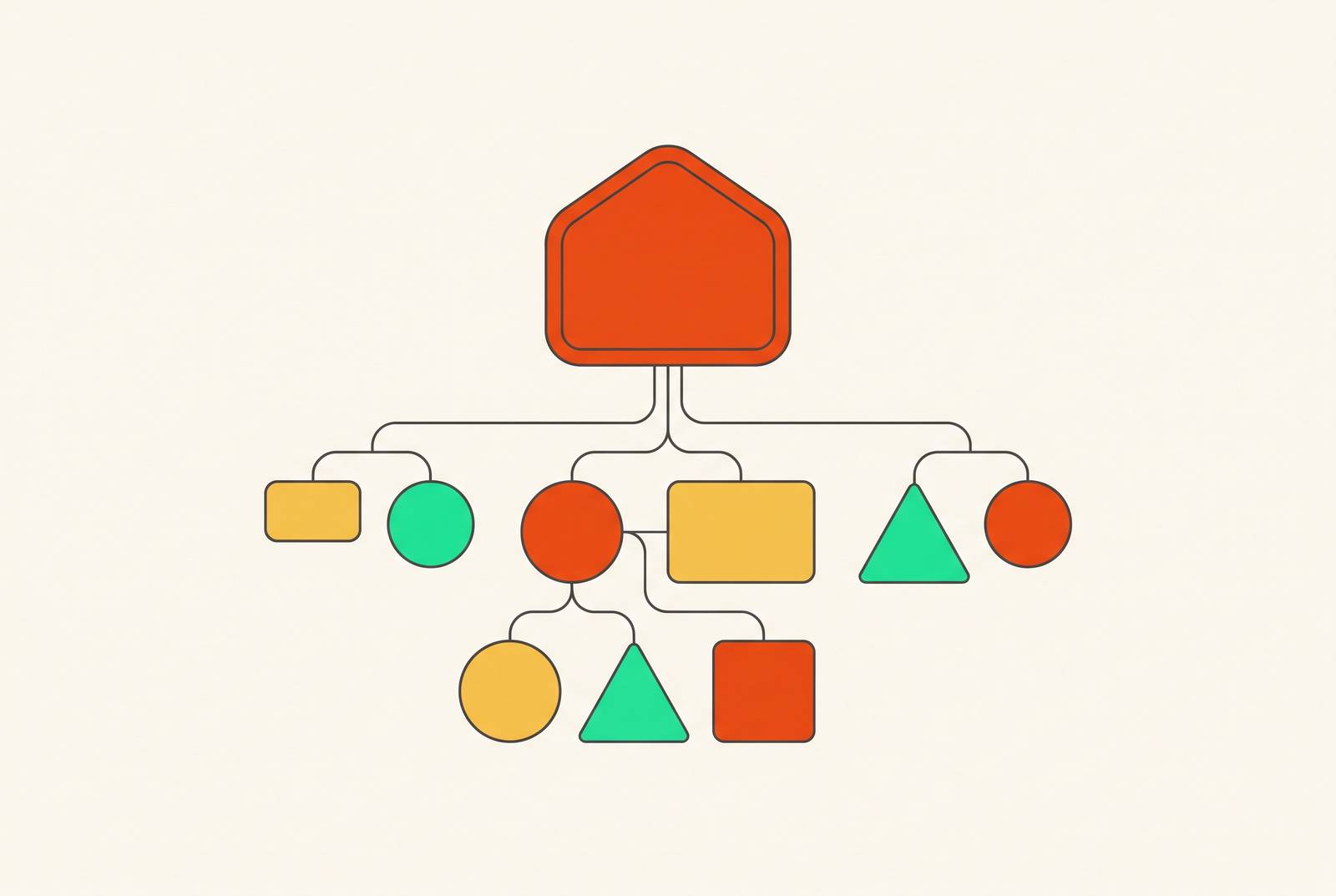
Picture two documents sitting side by side. One is the org chart, the tidy box-and-line diagram that shows who owns what, which subsidiary rolls up to which parent, who signs off on the budget. The other is what a customer actually sees when they land on the website, open the app, or sit through a sales call. Those two documents are rarely the same, and the gap between them is what brand architecture is built to close. Brand architecture is the system that defines the roles of a company's brands, products, and services, and the relationships between them. It decides which name leads, how visibly offerings connect, and when something earns its own identity, and that makes it a structural and strategic call, not a design preference.
Frontify's brand architecture guide says a clear structure does two jobs at once. It gives customers a way to understand what a company actually sells and how the pieces fit together, and it gives internal teams a shared basis for decisions about launches, acquisitions, naming, and design. That second part affects how every new product launch gets named, because without it, each launch turns into a fresh argument about what to call the thing. The B2B version of this problem runs even hotter. Brightscout's B2B brand architecture guide points out that B2B buyers evaluate ecosystems, not single products. Before signing a significant contract, they want to know how the offerings connect and who stands behind them. A confusing structure does not just cost a company some polish. It costs deals.
How brand complexity accumulates before founders notice it
Brand architecture rarely fails with a bang. It fails the way a junk drawer fails: one spare key at a time, until nobody remembers what half of them open. Brightscout describes the pattern directly. A company launches with one brand and one product. A feature gets popular enough to be promoted to a product. That product picks up an informal nickname internally, the nickname sticks, and eventually it grows into a sub-brand complete with its own logo and its own positioning deck. Nobody planned any of it. Each step made sense on its own, and the sum of those steps is a portfolio nobody can describe in one sentence.
The damage appears in lost revenue long before anyone calls it a branding problem. Sales teams end up pitching one brand while actually selling something else. Marketing and product start using different words for the exact same thing, so a prospect hears one pitch from the website and a slightly different one from the account executive. Prospects, faced with that mismatch, hesitate, and hesitation, as Brightscout notes, kills deals. Brickell Digital lays out the specific tripwires: more than one product is live and customers are visibly confused about how they relate, a new product targets a meaningfully different audience and forcing it under the existing brand creates positioning headaches, an acquisition has happened and two separate customer bases now need to understand how the companies connect, or employees in different parts of the business describe what the company does in noticeably different ways. None of these raise costs on a balance sheet right away. They just make every future change harder and more expensive, which is how Brickell Digital frames the compounding risk: once a company is large enough that one change touches many things at once, untangling the confusion gets costly fast.
When a brand architecture decision is not yet needed
Not every startup has this problem yet, and pretending otherwise just burns time a small team does not have. A single-product company with one audience and one clear value proposition does not need a brand architecture decision. Brickell Digital's view is that the structure is already implicit, and already sufficient. Spending a strategy sprint naming a "House of Brands" for a company that has exactly one brand and one house is a bit like alphabetizing a bookshelf with three books on it.
There is also a timing trap in the other direction: decisions made before a product has found its audience tend to be wrong, because architecture has to serve the commercial reality of the business, and in the zero-to-one phase that reality has not settled yet. Brickell Digital places the real decision point at Series A: when a two-product company has to decide whether the second product shares a landing page with the first, or when the company name that reassures investors turns out to confuse end users. Past that threshold, the choice of model carries real weight rather than remaining a someday problem.
The four models and the core trade-off each one makes
Once a company reaches that threshold, it helps to know there are really only four structural positions on the table, and each one answers the same underlying question differently: how much should the master brand's identity shape what a customer sees when they bump into any single offering?
Branded House puts the master brand in front, every time, with product names that simply describe what each one does. Google Workspace is the textbook example from Frontify: Google Docs, Google Drive, Google Meet, Gmail, Google Chat, Google Calendar, Google Sheets, and Google Slides all lead with the same name, and the descriptor after "Google" just tells you which tool you're looking at. This model fits related offerings whose customers reasonably expect the same underlying promise across the board. Frontify says the trade-off is that stretching one name across too many things dilutes its clarity, and a stumble with one product can shake confidence in the whole portfolio.
House of Brands goes the opposite direction. Individual brands lead with their own distinct identities, and the parent company mostly stays backstage. Frontify points to P&G's portfolio as the classic case: Tide, Pampers, and Gillette each own a different category, and most shoppers have no idea they share a parent company. This fits offerings with genuinely different audiences or positions, especially ones that would actively conflict if they shared a name. The cost, as Frontify puts it, is that each identity needs its own attention and investment. There is no shortcut to running four brands. It is four separate jobs wearing one trench coat.
Endorsed Brands sits in the middle. A distinct brand leads, but it carries a visible nod from the parent. Courtyard by Marriott is Frontify's example: Courtyard is the hotel brand customers book, and "by Marriott" tells them exactly who stands behind it. This model works well for a brand that benefits from the parent's credibility while still speaking to a different audience or price point, and it is particularly effective after an acquisition when the acquired company already carries real brand recognition of its own. Brightscout points to Atlassian as a live example. Frontify says the trade-off is that two identities now need clear rules so customers don't get confused about which one is actually making the promise.
Hybrid lets different relationships coexist across the same portfolio: some offerings share the name outright, some carry an endorsement, some stand entirely alone. Frontify's own example is Marriott again, which runs Marriott Hotels, Courtyard by Marriott, and The Ritz-Carlton all under one roof, using three different relationship types at once. This fits a mature or diverse portfolio where different products genuinely need different treatment. The cost is complexity itself: every exception to the rule makes the rulebook longer, and the more varied the relationships get, the harder the whole thing is to govern.
The decision logic that connects each model to a startup's actual situation
For most early-stage companies, the real choice narrows down to two of the four: Branded House or Endorsed Brands. Which one fits depends on two things a founder can actually observe without hiring a consultant: how much synergy exists between the products, and how different the buyers are for each one.
The heuristic, drawn from Mycali Designs' brand architecture guide alongside Brickell Digital, runs in a straight line. High synergy, defined as the same buyer, complementary use cases, and one shared underlying promise, points to a Branded House. Moderate synergy, meaning related buyers with some overlap but enough difference to need separate positioning, points to Endorsed Brands. Low synergy, meaning different buyers in distinct markets whose propositions would actively clash if connected, points to a House of Brands. A mixed portfolio spanning several of those levels at once points to Hybrid, though that is a destination for later-stage companies and rarely the right place to start.
Branded House is the correct default for most startups in that first category, and the logic behind it is almost entirely about compounding. Trust builds fast because every single customer interaction, across every product, reinforces the same name. Naming stays simple enough that nobody needs a glossary to explain the product lineup on a sales call. Marketing dollars concentrate on building one brand instead of getting split four ways, which matters enormously when the budget is small to begin with. Brightscout frames all three of these as the reasons Branded House wins by default early on. Mycali Designs notes that a Branded House carries substantially lower management costs than a House of Brands, and for a startup watching burn rate, that difference is often the deciding factor.
Endorsed Brands earns its place in two specific situations, and both are observable rather than theoretical. The first is post-acquisition, when the company being folded in already has real, independent brand recognition that would be wasteful to erase. The second is when a new product needs to reach a buyer who would be confused, or even put off, by the parent brand's existing reputation. Brightscout holds up Atlassian as the clearest current example of this logic in action, with Jira, Confluence, and Trello each carrying their own identity while the Atlassian name sits visibly behind them.
House of Brands, by contrast, is almost never the right starting point for a startup. Building independent brand equity across multiple names takes sustained investment that most early-stage companies simply do not have lying around, and Brickell Digital frames that cost gap as a decisive constraint rather than a minor inconvenience. Hybrid carries a similar warning label. Mycali Designs recommends that growing businesses start with a Branded House or Endorsed model and only consider a Hybrid once the portfolio has actually grown complex enough to need it. Introducing that complexity early just creates management overhead with no strategic payoff to show for it, a bit like installing a home elevator in a one-story house.
Before any of this gets decided, Brightscout flags one question as the one to answer first: is the new thing a feature, a product, or a sub-brand? Features belong inside a product, full stop (no further identity needed). Products can stand on their own but may not require a separate identity of their own. Sub-brands are the ones that actually carry independent positioning and market presence. Most of the bloat and confusion described earlier starts right here, with a feature mistakenly promoted into sub-brand status before anyone asked which category it actually belonged in.
What happens when startups get the model wrong
A wrong architecture choice rarely announces itself on day one. It sits quietly in the background, and the longer it sits, the more expensive it gets to touch, because by the time anyone notices, the company has grown large enough that every correction now ripples through sales decks, websites, contracts, and support documentation all at once.
For a B2B startup, the fallout is commercial rather than cosmetic. Brightscout points to three recurring symptoms: sales narratives that contradict each other depending on who's in the room, website information architecture that breaks every single time a new product launches, and buyers who hesitate because they cannot make sense of the portfolio at a glance. Each one creates real, measurable friction somewhere in the sales pipeline. The B2B buying committee makes this worse rather than better. When several stakeholders across different levels of an organization are all evaluating the same offering, a poorly structured portfolio adds cognitive load to an evaluation that is already complicated enough without it, and Brickell Digital notes that this structural ambiguity works against everyone sitting at that table, not just the company selling into it.
The fix is where the asymmetry really bites. Starting simple and expanding deliberately is far easier than consolidating a portfolio that has already fragmented. A Branded House can grow into an Endorsed model on purpose, one deliberate decision at a time, as new products genuinely need the extra room to breathe. A House of Brands that needs to consolidate has no such gentle path: it means stripping brand equity away from products that customers already recognize on their own, which is a much harder sell than it sounds, both to the market and to whoever has to explain the rebrand internally.